
How To Adjust Planting Spacing & Depth On Your Vegetable Transplanter?
Uniform planting spacing and accurate burial depth are core factors affecting vegetable seedling survival rate and final farm yield. Whether you plant tomatoes, peppers, cabbages or lettuce, calibrated machine settings ensure neat seedling arrangement, stable root growth and consistent field management.
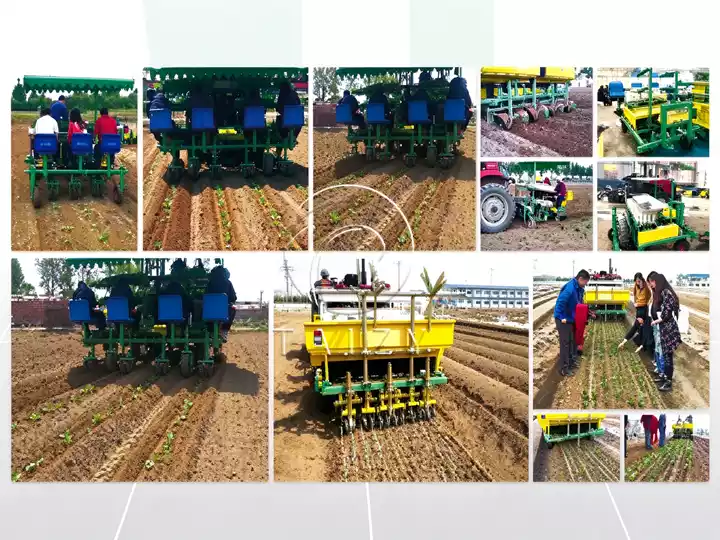
Different working scenarios require different types of vegetable transplanter equipment, including wheeled self-propelled, crawler self-propelled, and tractor-towed models. Though their structures differ, they share similar adjustable mechanisms for spacing and depth. This guide teaches you standard adjustment steps for all three machine types.
Why spacing and depth adjustment matters?
Improper planting parameters will cause obvious crop problems. Too-narrow spacing leads to nutrient competition and poor ventilation; overly wide spacing wastes field resources. Unmatched planting depth causes root exposure or stem rot, greatly reducing seedling survival rate.
Reasonable calibration allows your vegetable transplanter to adapt to different vegetable seedlings, soil conditions and planting modes, achieving standardized and high-yield field planting.
Three common types of vegetable transplanter
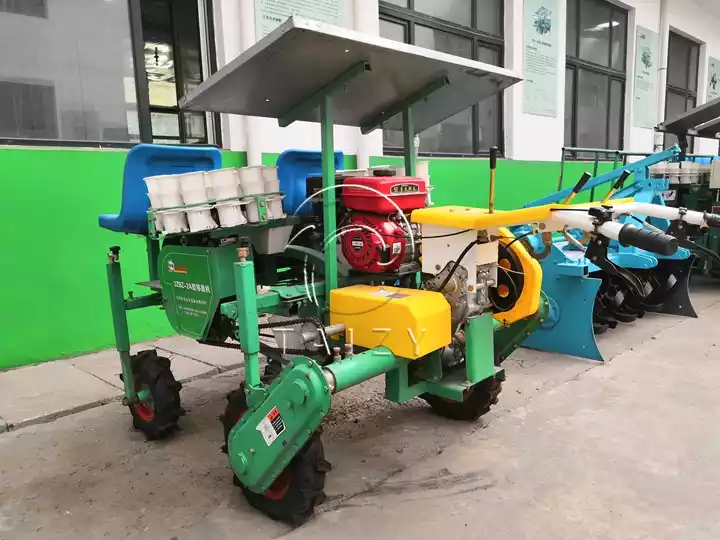
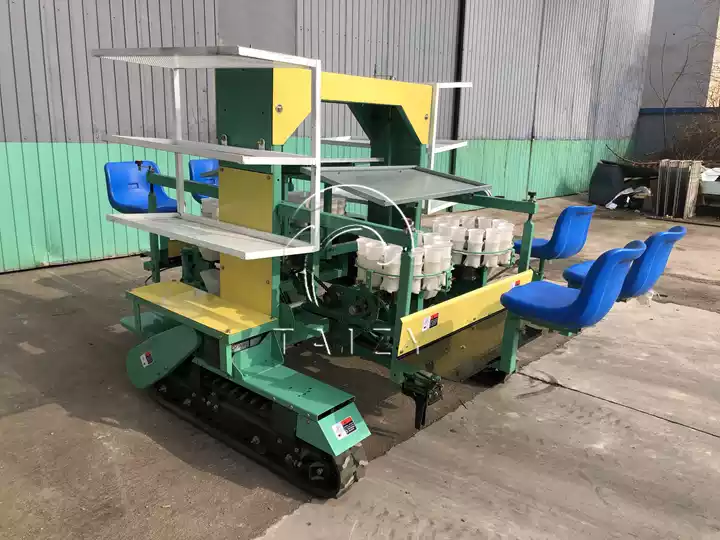
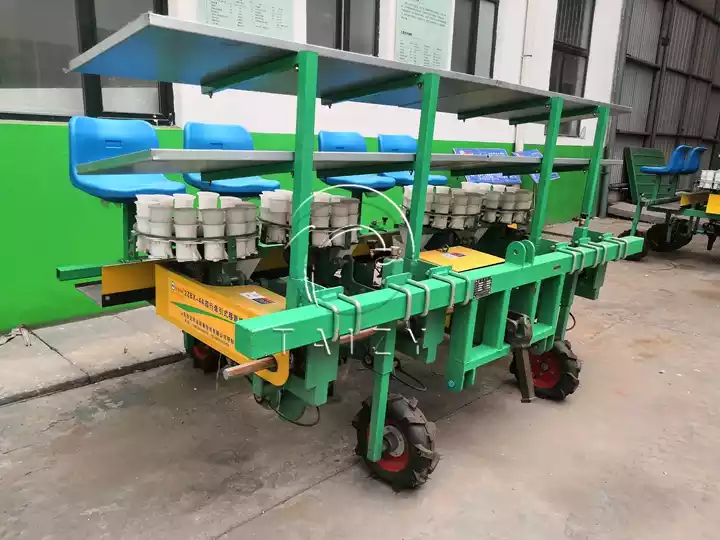
Before adjustment, confirm your machine type, as different models have slight differences in operation and adaptation scenarios:
- Wheeled self-propelled vegetable transplanter: Flexible and lightweight, suitable for flat greenhouse land and small-to-medium farm plots, with convenient parameter adjustment.
- Crawler self-propelled vegetable transplanter: Features strong terrain adaptability, anti-slip and anti-sink performance, ideal for muddy, uneven and large open farmland.
- Tractor-towed transplanting machine: Matches tractor power for high-efficiency large-area operation, widely used in commercial large-scale vegetable planting bases.
Pre-adjustment preparation work
Prepare basic tools before calibration to ensure accurate and efficient adjustment:
- Precision tape measure and adjustable wrenches
- Reference parameters for target vegetable seedlings
- Clean up soil and sundries on chains, sprockets and planting shoes
Clean equipment ensures no jamming during adjustment, applicable to wheeled, crawler and towed transplanters.
Adjust planting spacing on vegetable transplanter
Spacing adjustment controls the horizontal distance between each seedling, adapting to different vegetable growth space requirements.
- Wheeled and crawler self-propelled models: Adjust the walking speed gear and sprocket combination. Faster walking speed increases planting spacing, while lower speed shortens spacing. Fine-tune the transmission chain to fix parameter stability.
- Tractor-towed model: Match tractor driving speed and transplanter conveying frequency. Adjust the seedling discharging interval to change row spacing and plant spacing.
After adjustment, conduct a no-load test run and measure repeatedly to ensure uniform seedling spacing.
Adjust planting depth for all models
Planting depth determines whether seedling root blocks can be fully and stably buried in the soil.
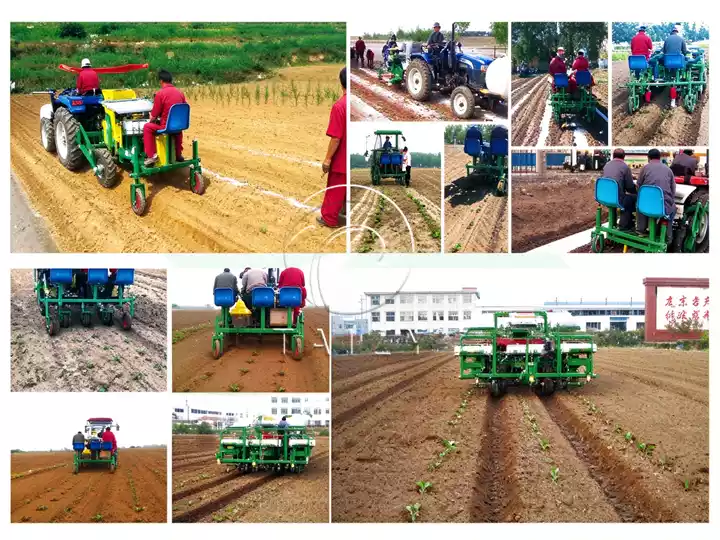
- Self-propelled (wheeled & crawler) transplanter: Use the bottom lifting bolt and depth limit handle to adjust the height of the planting shoe. Lower the shoe for deeper planting and raise it for shallower planting.
- Tractor-towed transplanter: Adjust the tractor suspension height and the machine’s depth limit wheel pressure to control the soil penetration depth of the planting mechanism.
The standard optimal state: the seedling root block is completely buried, and the seedling stem is exposed on the soil surface.
Field test and fine calibration
After parameter adjustment, a formal field test is essential for all three vegetable transplanter types.
Select a test field consistent with the formal planting land, plant seedlings with adjusted parameters, and check three key points: uniform seedling spacing, reasonable planting depth, and upright seedling placement. Fine-tune slightly according to soil hardness and seedling size until the best planting effect is achieved.
Common adjustment mistakes to avoid
- Blindly copying parameters without distinguishing wheeled, crawler and towed machine differences
- One-time large-scale adjustment instead of gradual fine-tuning
- Ignoring soil hardness changes, leading to inconsistent actual planting depth
- Skipping test runs and directly conducting large-area planting
Daily maintenance for stable parameters
Regular maintenance keeps your vegetable transplanter parameters accurate for a long time. Clean residual soil on planting shoes, sprockets and depth limit wheels after each use, regularly check bolt tightness, and lubricate transmission parts. This effectively avoids parameter deviation caused by equipment aging or blockage.
Conclusion
Mastering spacing and depth adjustment skills allows wheeled self-propelled, crawler self-propelled and tractor-towed vegetable transplanters to adapt to various vegetables and field conditions. Scientific parameter calibration improves seedling survival rate, reduces seedling waste and labor costs, and brings stable high economic benefits for commercial vegetable planting.