
How to Choose an Ideal Onion Seedlings Transplanter?
During onion cultivation, seedling management and transplanting efficiency directly impact yield and quality. Selecting a suitable onion seedlings transplanter not only enhances labor efficiency but also ensures uniform field planting and survival rates, laying the foundation for high yields.
Why transplant onion seedlings?
Although onion seeds can germinate at low temperatures of 3–5°C, the process is slow. The optimal germination temperature ranges from 12–20°C. Proper sowing timing is crucial for yield:
- Sowing too early: fall seedlings grow excessively fast, leading to premature bolting after overwintering and reduced yield.
- Late sowing: results in smaller seedlings with weak growth during bulb enlargement, leading to low yields.
Therefore, seedling cultivation followed by transplanting is a key method to increase yields. Transplanting pre-grown seedlings of appropriate size (leaf sheath diameter 6–7 mm, fresh weight 4–6 g per plant) during the optimal period prevents premature bolting while ensuring high-density, uniform planting at approximately 20,000 plants per mu.
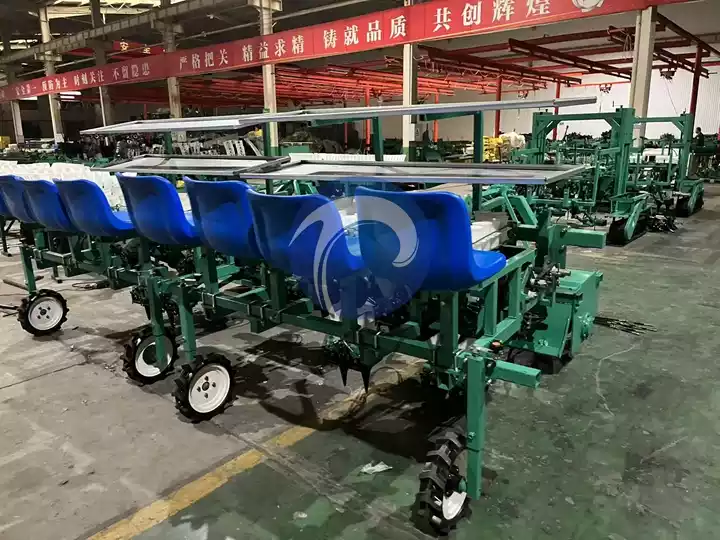
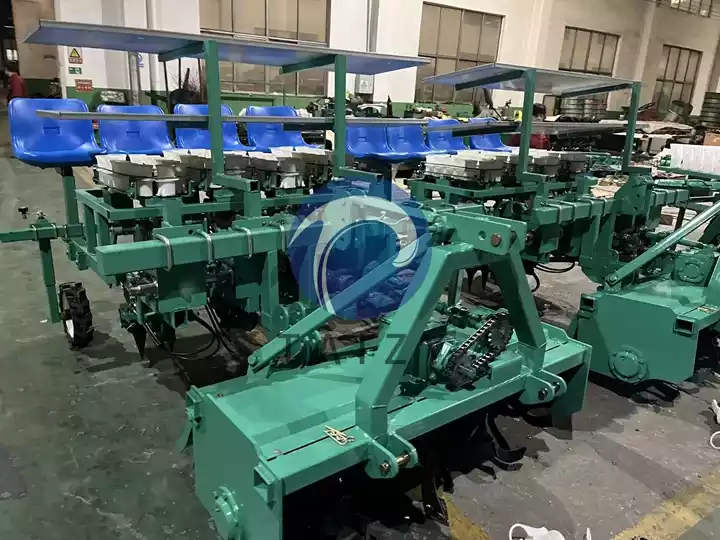
Key factors for selecting a onion seedlings transplanter
Number of transplanting rows and efficiency
An ideal onion seedling transplanter can transplant multiple rows of seedlings at once (e.g., 12 rows), significantly reducing labor and boosting efficiency. When combined with tractor-driven operation, it enables continuous large-scale planting, lowering labor costs.
Adjustable row and plant spacing
Recommended row spacing of 20cm and plant spacing of 16–17cm ensures uniform seedling distribution for maximum yield. Professional transplanters flexibly adjust row and plant spacing based on crop varieties and field conditions, accommodating diverse planting requirements.
Additional functionality expansion
Advanced onion seedling transplanters not only perform transplanting but also offer optional features:
- Laying plastic mulch to suppress weed growth.
- Laying drip irrigation tubing for precision watering.
- On-site watering capability to ensure rapid seedling establishment.
These features are particularly suited for large-scale onion cultivation, reducing labor demands and enhancing field management efficiency.
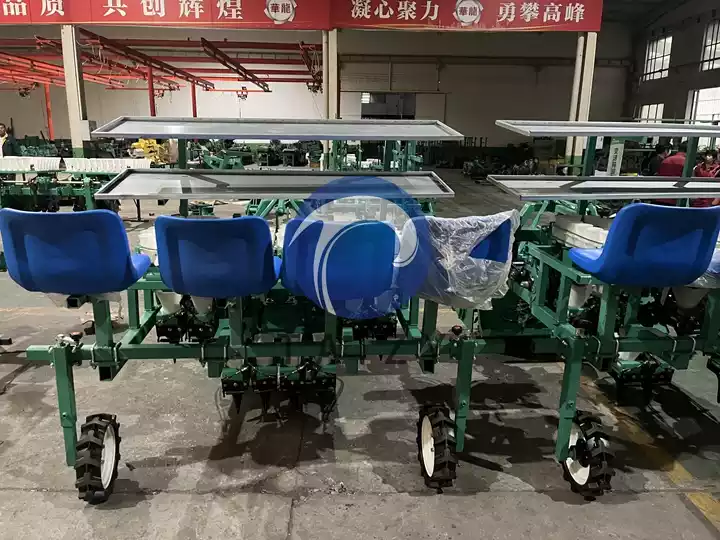
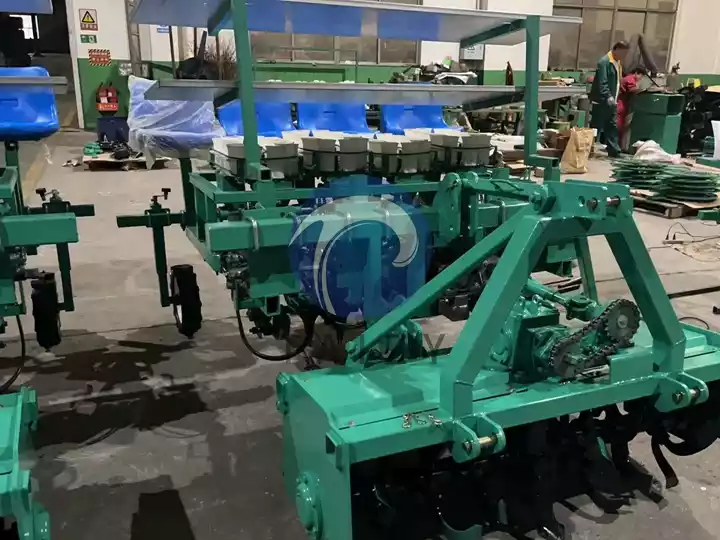
Suitable scenarios and tractor compatibility
The onion seedlings transplanter is not only suitable for large-scale flatland cultivation but can also be used in hilly terrain or greenhouse environments.
Typically, a tractor with 80 horsepower or more can efficiently drive a 12-row model. Higher-powered tractors can pull more rows at once, achieving greater production efficiency.
Conclusion
Selecting the appropriate onion seedlings transplanter not only ensures uniform planting and improved survival rates but also reduces labor costs and enhances field management efficiency. Advanced equipment featuring multi-row transplanting, adjustable spacing, and additional functions provides an efficient, intelligent, and reliable solution for large-scale onion cultivation.